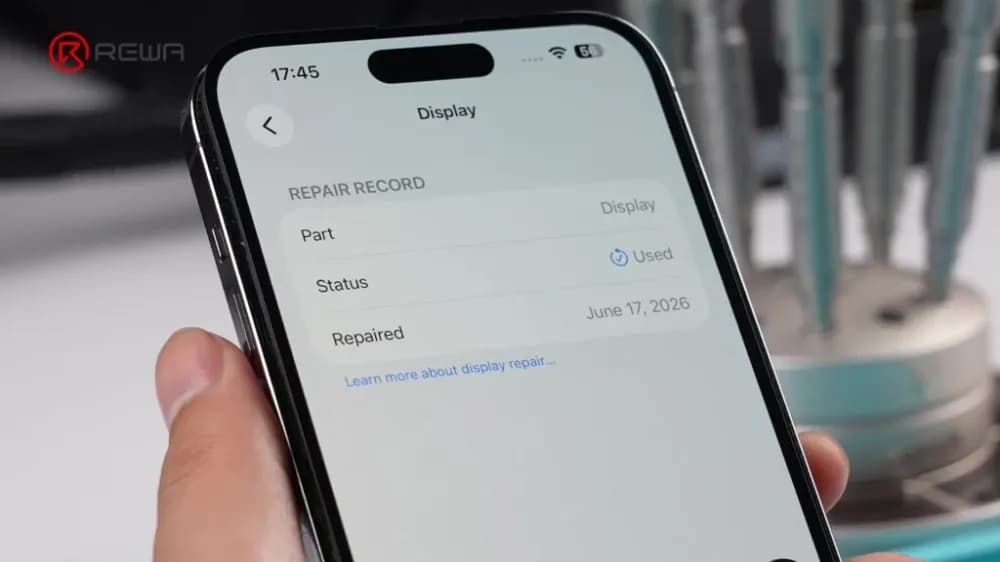
Apple’s Repair Assistant has transformed the way iPhone repairs are performed. Today, simply installing an aftermarket display or battery isn’t enough. To avoid the iPhone unknown part message, the replacement component must also be compatible with Apple’s Repair Assistant and successfully pass the post-repair diagnostic process. Using diagnostic-compatible parts helps ensure a seamless repair experience while preventing warning messages that can affect user confidence.
As a result, diagnostic-compatible screens and batteries have quickly skyrocketed in the mobile repair industry in 2025. They promise a much simpler installation process while avoiding the iPhone Unknown Part message that traditional third-party parts often trigger.
In this guide, we break down the technology behind diagnostic-compatible parts in plain English, discuss their advantages and limitations, and help you decide whether they’re the right choice for your repair business.
What Are iPhone Diagnostic-Compatible Parts?
A diagnostic-compatible part is an aftermarket replacement component engineered to work seamlessly with Apple’s Repair Assistant. After installation, it can successfully complete the pairing and diagnostic process, helping prevent the iPhone unknown part message from appearing. This allows users to enjoy a smoother repair experience while maintaining proper part recognition and system functionality.
Normally, third-party screens and batteries are not recognized as genuine paired components by iOS. As a result, users may see:
“Unknown Part” notifications
Limited functionality after replacement
Failure during Apple’s Parts Calibration process
Diagnostic-compatible parts are engineered specifically to overcome these problems, allowing many repairs to be completed without performing risky IC chip transplantation.
Simply put:
Repair Assistant is Apple’s software calibration system introduced for newer iPhones. After replacing certain components, technicians can run Repair Assistant to verify and calibrate the installed parts.
How Does a Diagnostic-Compatible Screen Work?
The technology behind diagnostic-compatible displays may sound complicated at first, but the basic concept is surprisingly straightforward. Let’s break it down step by step. The secret isn’t the OLED panel itself. Instead, the key component is the OEM pulled touch IC.
Since Apple’s encrypted calibration information is stored inside the touch IC, manufacturers transplant an original touch IC onto an aftermarket OLED display. This allows the screen to present itself to the system in a way that enables Repair Assistant to complete successfully.
The whole calibration process is like this:
Harvest an original touch IC from a donor screen.
Solder the IC onto an aftermarket OLED display.
Install the screen.
Run Apple’s Repair Assistant.
Complete Parts Calibration.
Why is the Front Sensor Flex Important?
There’s another important detail that many technicians overlook, especially on newer iPhones. After Parts Calibration, the front sensor flex cable becomes critical.
For iPhone 14 Series and earlier, the repair is relatively forgiving. As long as a compatible front sensor flex cable is installed, the screen can usually pass Repair Assistant.
For iPhone 15 Series and newer, requirements become much stricter. The front sensor flex must be either the original flex paired with the motherboard, or perfectly matched to the touch IC installed on the replacement screen. Otherwise, the calibration may fail even if the screen itself is diagnostic-compatible.
How Does a Diagnostic-Compatible Battery Work?
The same design philosophy also applies to batteries. Instead of relying on the battery cell itself, the key component is the Battery Management System (BMS) board.
The BMS board controls functions including charging, battery protection, power management, battery health reporting and fuel gauging. Diagnostic-compatible battery manufacturers replace the traditional aftermarket BMS board with:
an OEM pulled authentication IC
a control IC for battery management
After spot welding this BMS board onto a new battery cell, the battery can successfully complete Repair Assistant while still operating like a normal replacement battery.
Quick tip:
Fuel Gauging refers to the system that calculates the battery percentage displayed on your iPhone.
Advantages of Diagnostic-Compatible Parts
Diagnostic-compatible parts have become popular because they solve several long-standing repair challenges. Here’s why many repair shops are paying attention.
1. Lower Risk During Installation
Traditional solutions often require screen IC transplantation, battery BMS transplantation and precision microsoldering.
These procedures require expensive equipment and highly experienced technicians. Diagnostic-compatible parts significantly reduce the chance of technician-induced failures.
2. Faster Repair Turnaround
Without chip swapping, repairs become much quicker. For businesses, faster turnaround often means higher profitability.
Repair shops can:
Complete more repairs each day
Alleviate technician workload
Reduce customer waiting time
3. Lower Cost Than OEM Parts
Original Apple replacement parts remain expensive. Diagnostic-compatible parts provide many of the same user-facing benefits while costing considerably less, making them attractive for:
Chain repair shops
Distributors
Refurbishers
Second-hand device dealers
Hidden Risks You Should Know
Although diagnostic-compatible parts offer impressive convenience, they’re not a perfect solution. Like any emerging repair technology, there are several limitations worth considering.
Frequently asked questions
Can diagnostic-compatible parts permanently remove the iPhone Unknown Part message?
Not necessarily. They are designed to pass the current version of Apple’s Repair Assistant, but future iOS updates could change Apple’s verification mechanisms and affect compatibility.
Are diagnostic-compatible screens genuine Apple displays?
No. The display panel itself is aftermarket. However, it typically incorporates an OEM pulled touch IC that enables the authentication process.
Do diagnostic-compatible parts lower the risk of microsoldering?
Yes. One of the biggest advantages of diagnostic-compatible parts is that they fix the need for complex IC or BMS transplantation during installation.
What is the front sensor flex? Why is it important on iPhone 15 and newer?
The front sensor flex is the cable that connects components like the ambient light sensor and proximity sensor located near the front camera assembly. And Apple introduced stricter pairing requirements on iPhone 15 and newer. The front sensor flex must either be the original one paired with the motherboard or correctly matched with the replacement screen’s touch IC to complete calibration successfully.
Are diagnostic-compatible batteries as reliable as OEM batteries?
Reliability depends on manufacturing quality, the condition of the reused authentication IC, and the supplier’s quality control. Because the technology is still relatively new, long-term performance data is still developing.
Devices: iPhone 16 Pro Max, iPhone 15